The Story Behind Alek, Misi, and Rubi
When I take visitors through Istanbul, I work with what the city has left us: a wall that survived, a column brought from somewhere else, an inscription that gives us a name or a date. These remains allow me to explain what is known, even when much of the world around them has disappeared.
After more than twenty years as a licensed tour guide, I’ve become as interested in the limits of an explanation as in the facts themselves. I can show someone a surviving monument and tell them what we know about it. But there are countless lives that the stones cannot introduce us to.
One day, I began wondering what a different kind of story might look like.
What if I tried telling some of Istanbul’s stories through the eyes of the animals that have always shared the city with us?
That question eventually became Alek Misi Rubi.
Why a Seagull, a Cat, and a Mouse?
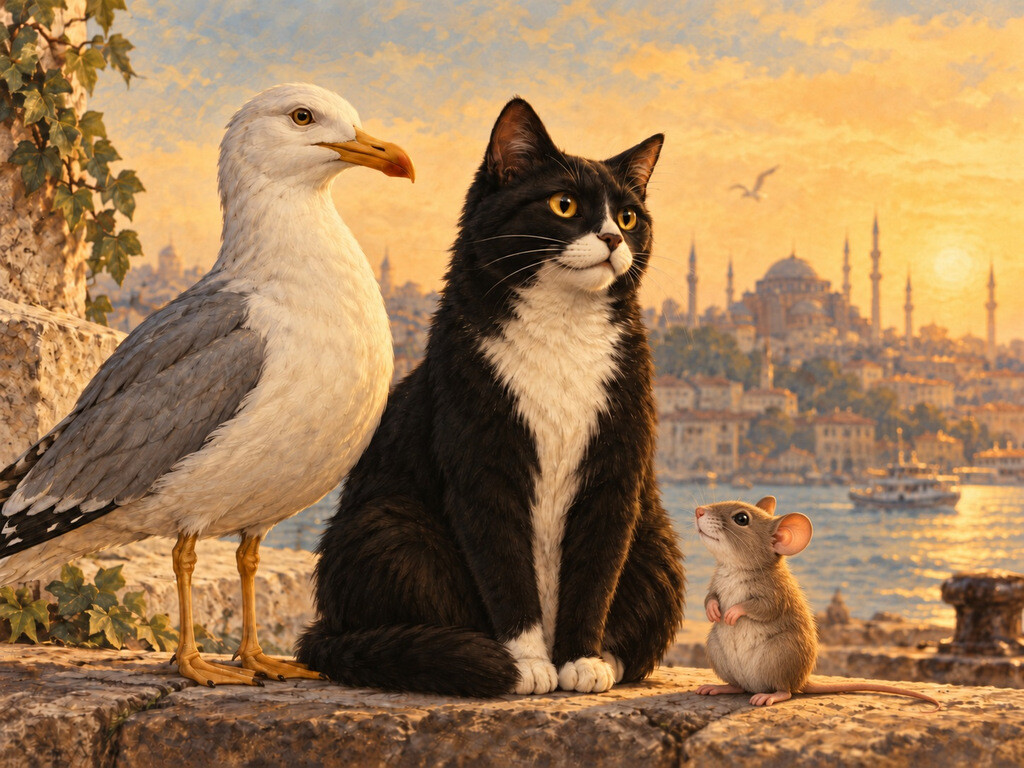
A seagull and a cat seemed natural choices. Both are familiar presences in Istanbul, as much a part of its everyday life as ferry horns, crowded squares, and open doorways.
But I wasn’t interested in making them miniature historians who happened to have feathers or paws. I wanted to imagine what would happen if their own habits, interests, and limitations shaped the telling of a historical event.
The mouse was a less obvious choice.
People rarely feel the same affection for mice that they do for Istanbul’s cats. That was partly what attracted me to Rubi. I liked the idea of asking readers to care about a creature they might ordinarily overlook—or hurry away from.
At first, I imagined him moving through the walls of old palaces, close to rooms where important conversations took place. He might overhear a few words without understanding their significance. But the more I thought about Rubi, the less I wanted to confine him to palaces and imperial secrets.
He belonged just as naturally among sacks in a storeroom, behind a kitchen wall, or beneath the wooden supports of a construction site.
In our first fable, Thirty Days, Thirty-Two, he is not listening to an emperor. He is beneath the timbers used to raise an ancient obelisk, waiting for the ground to stop trembling.
That seemed a much more interesting place for him to begin.
I also wanted these three animals to remain themselves. Within the world of the fables, their memories may reach across centuries. But they can still misunderstand what they hear, overlook something important, or forget.
None of them knows the whole story.
And sometimes, the part they fail to understand is as important as the part they witness.
Finding a Story Within History
The research comes first. I begin by asking what we actually know about an event: where it happened, what survives, which sources describe it, and where the evidence becomes uncertain.
I might know that a monument was erected under a particular emperor. An inscription, a written account, or an archaeological discovery may tell us something about the work. But the people who carried ropes, prepared timber, swept the ground, or watched from nearby often remain unnamed.
I cannot recover their private lives simply by imagining them.
What I can do is write a fictional moment around the known event, without asking the reader to mistake that moment for a historical discovery.
Sometimes Alek, Misi, and Rubi may witness the same event. Sometimes only one of them belongs in the story. I don’t want a fixed arrangement of characters to determine what happens. The story should grow from the setting and from what its witness could plausibly experience.
This is why every fable includes The History Behind the Fable, a section in which I explain the historical foundations, identify the sources, and distinguish documented details from fictional scenes and characters.
The story can be enjoyed on its own. But I want readers who become curious about the real history to have somewhere to go next.
How I Create These Stories
Writing these fables involves historical research, imagination, drafting, and repeated revision.
I also use AI tools during the creative process. They can help develop drafts, explore alternative scenes, review historical and narrative consistency, and create illustrations. Their usefulness does not make them historical authorities.
A convincing sentence is not necessarily a true one. An illustration may capture the atmosphere of a period while getting an architectural detail wrong. Both need to be examined.
I use historical sources to check factual claims and review whether the characters’ actions and observations make sense within their imagined world. The creative direction, literary decisions, and responsibility for the published work remain mine. Every story and illustration is reviewed, edited, and approved before publication.
For me, these tools are part of the process, not the subject of the project.
The subject is still Istanbul, its history, and the stories that imagination can tell without taking the place of evidence.
Other Ways I Tell Istanbul’s Stories
My work as a guide and historical writer continues beyond these fables.
At IstanbulClues.com, I write about Istanbul’s monuments, museums, neighborhoods, and history, drawing on my years of experience exploring the city with visitors.
Byzantine Stories is a separate narrative project concerned with the Byzantine past and its historical sources. It follows a different creative approach and is not another chapter of Alek Misi Rubi.
The Turkish edition of these fables is published at AlekMisiRubi.com. Each language has its own rhythms and possibilities, and the stories are written independently rather than translated word for word.
These projects reflect different interests in history and storytelling. They are connected by the person creating them, not by a single fictional universe.
A Different Way to Remember a Place
There are places in Istanbul that I have visited hundreds of times. I know where to stand to explain their history. I know which details visitors tend to notice, and which ones they sometimes walk past.
But writing Alek, Misi, and Rubi has given me another reason to look.
An old stone is still an old stone. Its date and history do not change because I have imagined a mouse beside it.
What changes is the question I bring to it.
Perhaps that is what I hope these fables will offer their readers: not a different history, but an unfamiliar way of approaching the one we share.
And if our paths cross in Istanbul one day, I would be happy to show you some of the real places behind these stories.
Until then, welcome to their pages.
Serhat Engul
Istanbul
Told by Wing, Whisker, and Whisper.