Three Witnesses at the Obelisk of Theodosius
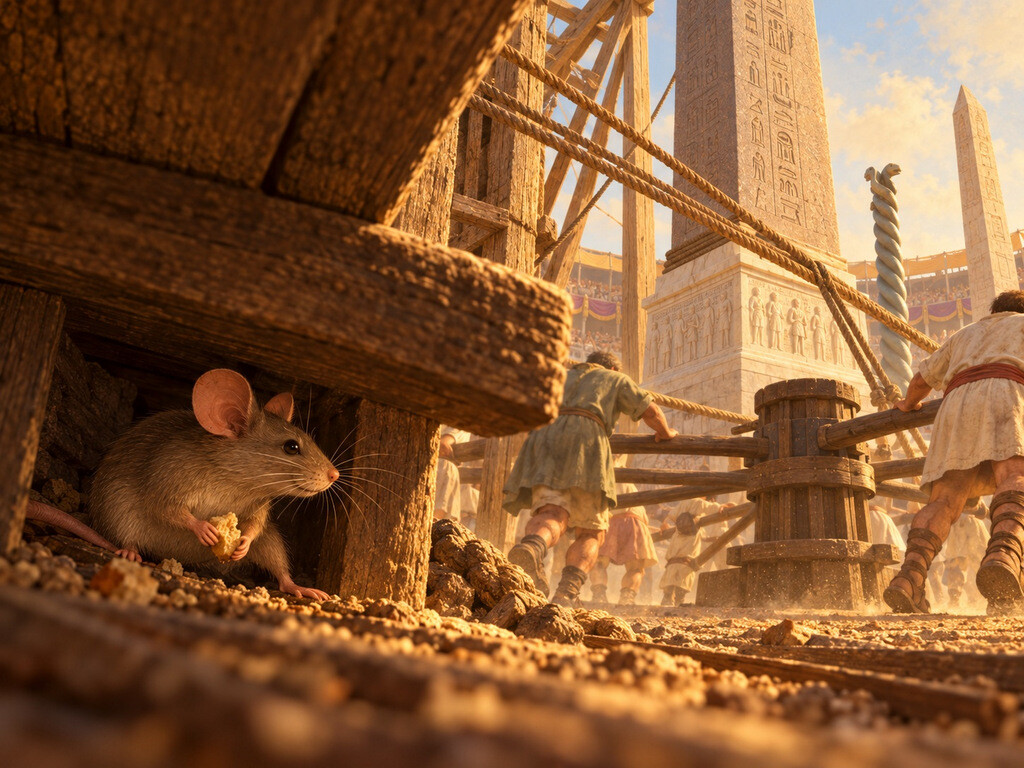
The rope above Rubi’s head had been complaining since morning.
At first it had made a low, steady creak, the sort of sound a mouse could sleep through if there were nothing better to do. Then the creak grew sharper. Dust came down from the timber. Something heavy shifted beyond the narrow opening where Rubi had hidden himself.
Rubi stopped eating.
Through a gap between two planks, he could see a man’s foot braced against the ground. His sandal had been repaired with a strip of leather that was already coming loose. Farther on, another pair of feet moved past, then came around again. The men were walking in a slow circle. Each time they passed, the timber above Rubi creaked and the rope drew tighter.
Rubi could not see what they were lifting. He knew only that it was very large and that the men were taking a great deal of trouble over it.
Then the rope tightened again, and his little shelter shuddered.
He backed away, taking the last crumb with him. There was no sense in letting a magnificent human undertaking ruin a perfectly ordinary breakfast.
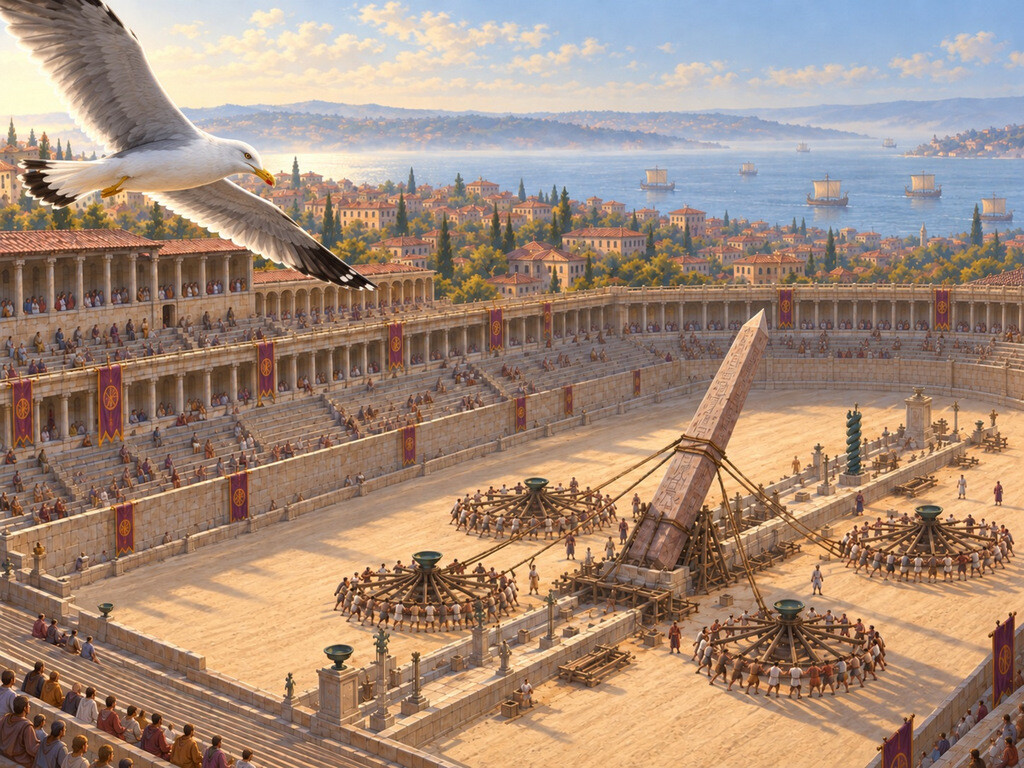
From the air, Alek could see the undertaking whole.
A long granite obelisk was being raised along the central barrier of the Hippodrome. Around it stood timber frames and windlasses. Men pushed long wooden bars around the turning drums, while ropes stretched taut toward the great shaft. Beyond the arena lay Constantinople, its roofs descending toward the water. The Sea of Marmara shone beneath the morning haze.
Alek made a slow circle above the track.
He had seen the city fill its public spaces for races and ceremonies. This gathering was different. Nobody was watching horses. Every face seemed turned toward a piece of stone that had been old long before it reached these shores.
Its sides carried unfamiliar carved signs: birds, figures, and shapes that belonged to another kingdom and another language. The city was preparing to give that stone a new place—and, Alek suspected, a new meaning.
He tilted one wing and watched its pointed end climb higher against the sky.
From where he flew, the men were almost invisible. Yet the stone did not move without them.
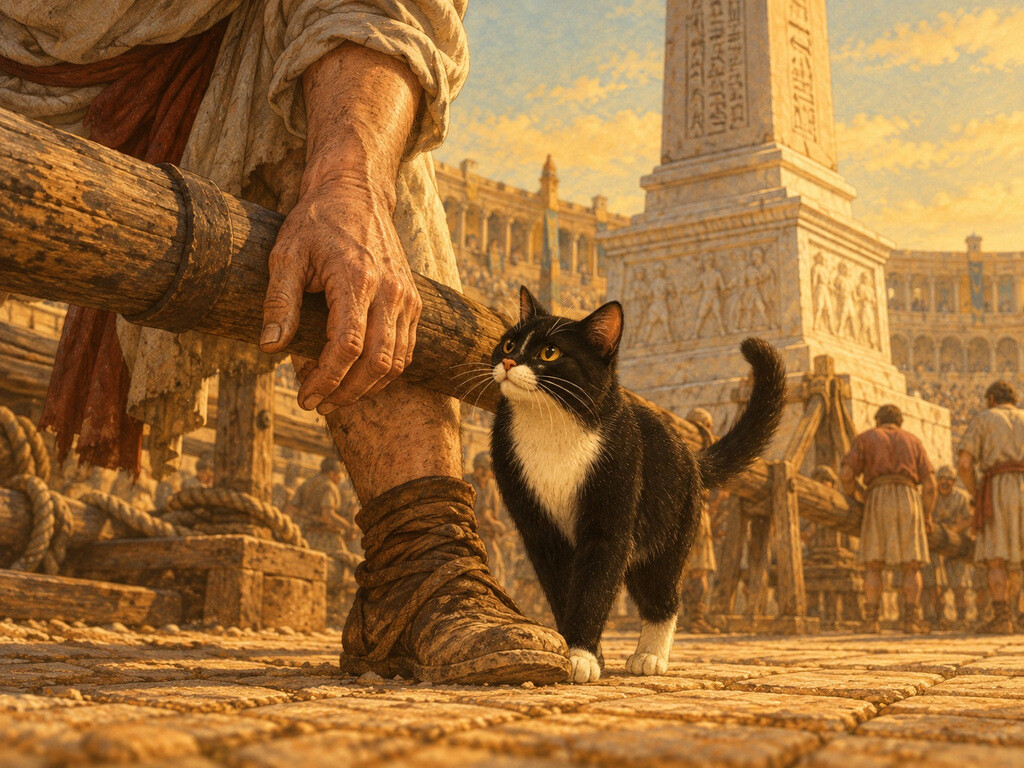
Misi had found a position near the edge of the Hippodrome, far enough from the work to avoid being trampled and close enough to study the people.
The stone interested her, though not as much as the men beneath it.
One had a raw patch across his palm. He kept closing his fingers around a wooden bar, then opening them as if surprised that his hand still belonged to him. Another wiped his face with his forearm and left a streak of dust along his cheek.
There was shouting, but Misi paid attention to what happened between the shouts. A man passed a water vessel to the worker with the injured hand. The worker drank, gave it back, and returned to his place without a word.
Misi watched him go. The great stone had not yet stood upright, and already the man’s shoulders had begun to droop.
Then the shouting stopped.
Even Misi looked up.
For a moment the obelisk seemed to hang between falling and standing. The ropes strained. The men held their places. Somewhere beneath the timber, a mouse felt the ground tremble through all four paws.
The stone moved the last little distance.
It stood.
A roar rose from the Hippodrome. Alek climbed with the sound. Rubi waited for the planks to settle. Misi kept watching the worker with the injured hand.
He was no longer pushing. His fingers remained curled, as though he still gripped the bar.
Misi crossed the dust and brushed against his ankle.
The man looked down, startled. Then, very carefully, he opened his hand.
In time, marble reliefs and inscriptions made a permanent account of the event.
The emperor appeared on the pedestal, presiding over the world of the Hippodrome. Elsewhere, workers, windlasses, and taut ropes were carved into the stone. In Latin, the obelisk itself was made to speak: it had resisted, then submitted to Theodosius and been raised to the heavens.
The Latin inscription counted thirty days.
The Greek counted thirty-two.
Rubi had never been much interested in counting days. He remembered the moment when a small strip of daylight appeared beneath a great weight, and the practical importance of keeping his tail out of the way.
Misi remembered a hand that had forgotten how to open.
Alek remembered the shape of the Hippodrome from above, and the instant a low, horizontal line became a point against the sky.
The centuries rearranged the square.
The racing track vanished from use. The imperial stands disappeared. Buildings rose, changed, and were replaced. The ground around the pedestal climbed until parts of its sculpted history lay buried; much later, people dug down again to uncover them.
The obelisk remained where it had been raised.
On a mild afternoon in today’s Sultanahmet Square, a visitor paused by its railing and read from a guidebook.
“Thirty days,” she said.
Her companion moved around to the other side. “This one says thirty-two.”
They examined the inscriptions and tried to settle the difference.
Misi, stretched out in a patch of sunlight nearby, listened for a while. Then she turned her attention to an older man resting his hand on the railing. He had been standing too long. She could tell by the way he shifted his weight before moving away.
Above the square, Alek crossed the obelisk’s narrow shadow and banked toward the sea.
And Rubi, somewhere close to the old stonework, found a passage scarcely wider than his whiskers.
The two visitors were still debating the numbers when he slipped through it.
On the marble pedestal above him, the carved workers still leaned into the bars of their windlasses.
They had not let go.
The History Behind the Fable
The Obelisk of Theodosius, in today’s Sultanahmet Square, originated in the temple complex of Karnak in Egypt. It was made for Pharaoh Thutmose III in the fifteenth century BCE. The surviving granite shaft was re-erected on the central barrier (spina) of Constantinople’s Hippodrome in 390 CE, during the reign of Emperor Theodosius I, under the supervision of the city prefect Proculus. Proculus later fell from favor and was executed in 393; his name was chiseled from the base and restored after Theodosius’s death.
The pedestal is an unusually vivid historical source. Its reliefs depict the imperial court, scenes connected with the Hippodrome, and the raising of the obelisk with ropes and windlasses. Its two principal inscriptions do not agree on the length of the operation: the Latin gives thirty days, the Greek thirty-two. Their wording also celebrates imperial power; the Latin inscription speaks as though the obelisk itself had been conquered and made to obey. The exact sequence of the obelisk’s journey from Egypt to Constantinople is less certain than the date of its erection.
What is imagined: Rubi’s hiding place, the anonymous laborers’ gestures, the injured hand, the exchange of water, Misi’s encounter, and the three animals’ memories are fictional scenes. They are not claims about named historical people. The moving viewpoints and the final encounter in today’s square belong to the fable.
Historical references: The obelisk and inscriptions — Livius; Istanbul Metropolitan Municipality’s monument record; The raising scene and windlasses — The Byzantine Legacy; Adrastos Omissi, “Damnatio Memoriae or Creatio Memoriae?”, The Cambridge Classical Journal 62 (2016).
For a closer look at the site: The Hippodrome of Constantinople — Istanbul Clues.